


Every service we use online today is connected and accessible more than ever before. Through federated identity systems, a single login can grant access to dozens of online services, creating a convenient, seamless, and interconnected online experience. For example, authenticating using a single provider such as Google or Apple gives users the ability to log in to multiple services without having to maintain separate accounts.
The modern messaging and social media services, which are built on trust-based security models and cloud storage servers, further blur the boundaries between applications, corporations, and authorities. It is true that this interconnectedness has made messaging convenient. But at what cost?
For it has simultaneously expanded the amount of personal data that is exposed online. Every chat, every conversation is becoming behavioral analysis data to feed and generate personalized commercials.
Yet, these service providers ask you to trust them even though they may not be transparent about their data collection, data usage, and data misuse policies.
As users become more aware of the limitations of trust-based messaging services, many are turning to privacy messaging apps built around Zero Trust principles, a modern security framework designed to minimize reliance on implicit trust.
It operates on a core principle, “Do not assume trust, always verify."
With Respect to BChat, Below Are the 5 Pillars of Zero-trust Systems
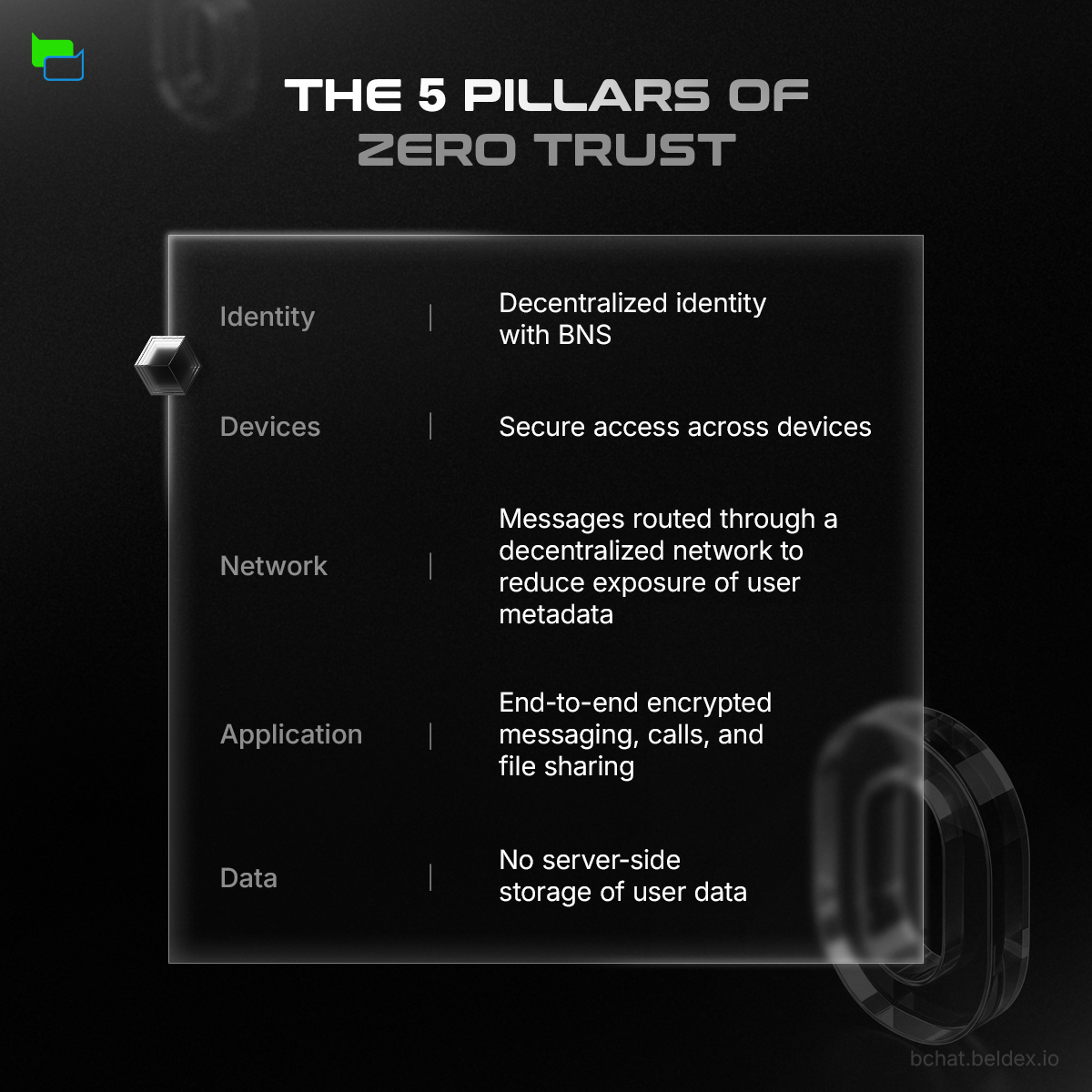
Core Principles of Zero Trust
Continuous Encryption: Encryption is one of the core principles of Zero Trust. BChat achieves this by end-to-end cryptographic encryption of peer-to-peer communication. Every interaction in BChat is authenticated through cryptographic keys.
Continuous Authentication: Continuous authentication is another principle of zero-trust. On the Beldex network, the masternodes are continuously authenticated to ensure that they provide the minimum required bandwidth and storage capacity to support functions like peer-to-peer messaging.
Least Privilege: "Least privilege" in common means offering selective control for a person or service that needs to perform the duty. But in BChat, there is no selective revelation; BChat follows the principle of minimizing access to user data and system resources.
Why is Zero Trust Essential Today?
The credential-backed attack is a cyberattack where advertisers use stolen, phished, and brutally forced usernames and passwords to gain unauthorized access to systems, applications, and data.
This remains one of the biggest threats to digital privacy and communication security. But privacy messaging app BChat reduces the risk through its privacy-first architecture, decentralized design, and a censorship-resistant ecosystem.
How Does Zero Trust Work on BChat?
Zero trust is a framework and a differentiated architecture. At a higher level, this is how the architecture works.
End-to-End Encryption: All messages, voice calls, video calls, and shared files are protected with end-to-end encryption, ensuring only the intended recipients can access the content.
Privacy-First Architecture: BChat minimizes the collection and storage of user data, reducing exposure to potential security risks while protecting user privacy.
Decentralized Identity Management: Users can utilize BNS (Beldex Naming System) for secure, human-readable identities without relying on centralized account systems.
Data Sovereignty & Security: Communications are protected through decentralized routing and encryption, ensuring users maintain greater control over their data and digital interactions.
Privacy Messaging Application that Operates with Zero-Trust
Surveillance takes the front seat on most messaging platforms. Messaging tools provide major attack vectors like phone numbers, which is evident from recent attacks against WhatsApp and Signal.
Trust in centralized systems is not the same as trust in decentralized platforms.
Decentralized applications, by being zero-trust from the get-go, ensure that users don’t have to rely on the platform to protect their data. No data collected means none exposed.
Trustless platforms, instead of asking users to trust a company’s policies, intentions, or promises, eliminate trust entirely through transparent protocols, decentralization, and data minimization.
For decades, users have trusted multiple online messaging services that promised not to collect any user data, but these platforms now act as a data pool for targeted commercials. But now, the shift to trustless systems is evident and shows a change in how people view digital communication today. Every piece of information you share online can become a target, and the most effective way to protect your data is to ensure it is never collected in the first place.
 back to blog