


The centralized messaging apps often purport the convenience of communication, but they come with some tradeoffs like privacy risks, metadata leaks, and lack of chat control for the users.
Privacy messengers flip the script. Let’s see how this works.
Many communication platforms are surreptitiously collecting our data and monetizing it. This trend is destructive to user privacy. In 2025, nearly 3.5 billion WhatsApp accounts were leaked, including public keys, making it one of the biggest data leaks in history.
But a decentralized messenger operates on a completely different model. The privacy messaging apps are less focused towards collecting user data while prioritizing user sovereignty, privacy, and security.
Here are some of the reasons why you should opt for privacy messengers over centralized messaging apps.
6 Reasons to Choose Decentralized Messaging Apps
1. The Problem of Trust in Centralized Messaging Apps
Most centralized messaging systems rely on trust. They ask the users to trust them without demonstrating the reasons to do so.
Even an end-to-end encrypted messenger that hides the content of the messages still collects the metadata, which includes timestamps, the type of message sent, duration and frequency of connection, and the size of the message.
This information can be used to deanonymize users by correlating the data across different platforms to identify the person behind each phone number.
But the BChat privacy messaging app doesn’t require your phone number, email ID, or any other unique identifiers. It operates with decentralized nodes, which makes it stand out from platforms that rely on centralized servers.
Decentralized private messaging does not require trust because they’re trustless, permissionless, and autonomous. They don’t operate on a centralized server/database, hoovering up and storing the sensitive information.
2. No Commercial Ads
One of the fundamental differences between centralized and decentralized messaging platforms is that they are more focused on advertisements. Conventional messaging apps rely on advertising revenues. Meta generated over $196 billion in ad revenue last year. WhatsApp, which once rejected advertising and focused on security, has now rolled out ads on its own platform.
“These days companies know literally everything about you, your friends, and your interests, and they use it all to sell ads.”
- Stated by WhatsApp back in 2012 before it was acquired by Meta in 2014.
Changing teams and policies compromised the app’s security and privacy and introduced metadata collection and advertising.
But metadata collection is not directly related to ads. Regardless of whether they show ads or not, many messengers still collect phone numbers, which is a form of metadata that has led to egregious attacks and exposure of government IDs.
3. No Geo-Restrictions
Geo-restrictions are a common occurrence on centralized platforms. Authorities can restrict the availability and accessibility of any privately owned/centralized communication platforms. Countries can prompt the platform to stop being accessible in certain geolocations.
But privacy messengers operate on several community-run nodes distributed across multiple countries and even continents. In some regions, certain nodes may be blocked, but others continue to establish alternative paths. This ensures that @BChat_official is always live, up and running.
But how to access BChat if it doesn’t connect in your region - Read Here.
4. No Central Point of Failure
When a platform operates on a single server, there are chances of outages.
SPOF (Single Point of Failure) in a centralized system is caused when a master server, database, or network switch fails, causing the entire system to stop functioning. The centralized system lacks redundancy, making it vulnerable to targeted attacks and causing total downtime, data loss, and data or security breaches.
There have been many downtime incidents concerning centralized messengers in recent years. Decentralized messengers can bypass this issue by design; they don't rely on a single server. The BChat privacy messenger routes messages through different nodes (at least 3) before reaching the receiver.
BChat masks your IP address by routing your messages through several masternodes in the Beldex decentralized network.
5. Immutable Records
The Beldex blockchain ensures that the messages sent are tamper-resistant. This is important for maintaining a transparent and reliable communication history, which is particularly useful in professional or legal contexts.
6. Complete User Control
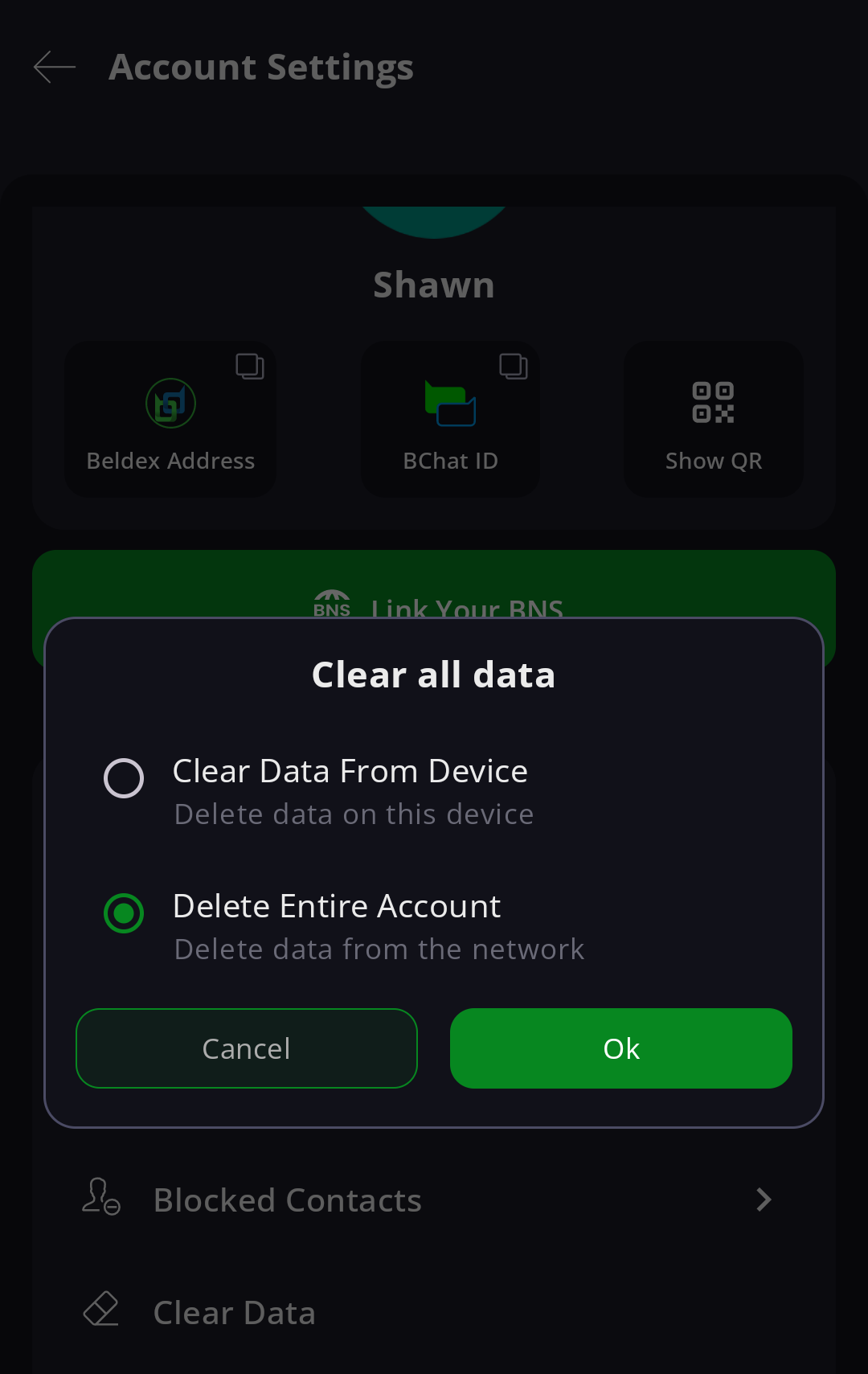
Centralized messaging apps don't give the chat control to users. Every message you send, photo you share, and call you make passes through the infrastructure owned by the centralized corporation. Bchat’s decentralized messaging by design operates on a fundamentally different model. Instead of operating under a single entity, the network is maintained collectively by independent masternodes, giving users complete control over their chats. If you want the chat deleted from the network, you can do it with the single tap of a button.
Settings -> Clear Data -> Delete Entire Account
Privacy is a Basic Human Right
Privacy protection has been phased out in recent times. Snooping into users' privacy was once considered an egregious thing to do. But now, several corporations, ad companies, and authorities are shifting the baseline and normalizing mass surveillance. Which was once tagged as "Don't be evil" is now becoming just a product requirement.
So, users are in a position to protect their privacy and personal information. We can’t entrust centralized systems with our trust and sensitive data, because they’re prone to breaking it, time and again. The solution is to stop implicitly choosing messaging services that compromise our privacy.
Join our community to know more about our recent developments.
 back to blog